
Good software development is more than writing code that works. Developers need to understand requirements, choose practical solutions, write maintainable code, test changes, protect applications, and improve software after release.
The term “Drovenio software development tips” is commonly used by people looking for practical software development guidance connected with technology topics associated with Droven.io. It should not be confused with a programming language, software framework, or formal engineering methodology.
This guide covers practical development practices that can be applied throughout the software lifecycle, from planning and coding to testing, deployment, and maintenance.
What Are Drovenio Software Development Tips?

Drovenio software development tips can be understood as practical software engineering recommendations for creating applications that are reliable, secure, maintainable, and useful.
The phrase does not describe a specific framework or development methodology. Instead, it focuses on practices such as:
- Defining requirements before coding.
- Building programming fundamentals.
- Writing clean code.
- Using version control.
- Testing continuously.
- Building security into development.
- Reviewing code.
- Maintaining documentation.
- Improving performance.
- Automating development and deployment.
- Using AI coding tools responsibly.
- Considering usability and accessibility.
The goal is not to follow every technology trend, but to build a development process that consistently produces better software.
What Does Droven.io Have to Do With Software Development?
Droven.io is associated with technology-focused information, which helps explain why its name can appear alongside software development searches.
However, developers should distinguish between technology information associated with a platform and an official software development methodology. Someone searching for “Drovenio software development tips” may simply be looking for advice about coding, testing, security, development tools, or modern engineering practices.
For that reason, this guide focuses on practical software engineering knowledge without claiming that these practices form an official Droven.io framework.
Why Do Developers Search for Drovenio Software Development Tips?

Developers can understand programming syntax and still struggle with engineering decisions, such as:
- How should requirements become development tasks?
- Which functionality should be tested first?
- How should Git changes be organized?
- When should performance be optimized?
- How should security be handled?
- How should AI-generated code be reviewed?
- What technical decisions should be documented?
These questions concern the software development process, not just programming. Good development practices explain both what to do and why it matters.
1. Start With Clear Software Requirements
Starting development before understanding the problem can lead to unnecessary features, rework, scope changes, and technical debt.
Before coding, define:
- The problem the software should solve.
- Target users.
- Core features.
- Inputs and outputs.
- Supported platforms.
- Security and privacy requirements.
- Performance expectations.
- Project constraints.
- Success criteria.
Break Requirements Into Smaller Tasks
Large requirements are easier to implement when divided into smaller, testable tasks.
For example, instead of “Build user authentication,” break it into registration, input validation, secure password storage, login, session management, password recovery, and authentication testing.
This makes development, testing, and code review easier to manage.
2. Build Strong Programming Fundamentals
Frameworks, cloud services, and AI tools can speed up development, but they do not replace programming fundamentals.
Developers should understand:
- Variables and data types.
- Control flow.
- Functions.
- Data structures.
- Algorithms.
- Error handling.
- Problem decomposition.
- Time and space complexity.
Focus on Problem Solving
Programming languages change, but problem-solving skills remain useful. Developers who can break complex problems into smaller parts can transfer those skills between languages and frameworks.
Strong fundamentals also make debugging easier because developers can reason about problems instead of relying on random fixes.
3. Write Clean and Maintainable Code
Code should remain understandable to developers who did not originally write it.
Maintainable code is generally:
- Readable.
- Consistent.
- Focused.
- Testable.
- Predictable.
- Reasonably simple.
Use meaningful names and keep functions focused. Avoid unnecessary nesting and complicated logic.
Comments should explain context or design decisions rather than obvious actions. For example:
// Cache this response because the external API has strict rate limits
is more useful than:
// Add 5 to the variable
Linters and formatters can also help maintain consistent coding standards.
Prefer Simplicity
A highly clever implementation is not necessarily better. When a straightforward solution works effectively, it is often easier to maintain.
4. Use Version Control From the Beginning
Git helps developers track changes, compare versions, revert mistakes, collaborate, and review development history.
Keep Commits Meaningful
Each commit should ideally represent one logical change.
Examples include:
- Add password reset endpoint.
- Fix authentication validation.
- Add login tests.
- Update API documentation.
Meaningful commits make debugging and rollback easier. Short-lived branches and regular integration can also reduce merge problems.
5. Test Software Continuously
Testing should begin during development rather than being postponed until the project is nearly finished.
Unit Testing
Unit tests check individual functions, methods, or components and are useful for isolated business logic.
Integration Testing
Integration tests verify that components work together, such as an API communicating correctly with a database.
End-to-End Testing
End-to-end tests validate complete user workflows, such as:
Sign up → Verify account → Log in → Create data → Log out
Important user workflows deserve particular attention.
Fix Flaky Tests
Tests that randomly pass and fail reduce confidence in the test suite. Investigate problems related to timing, external dependencies, shared data, or environment differences instead of repeatedly rerunning the test.
6. Build Security Into the Development Process
Security should be considered throughout development rather than added immediately before launch.
Important areas include:
- Input validation.
- Authentication and authorization.
- Secrets management.
- Dependency security.
- Access control.
- Data protection.
- Secure configuration.
- Error handling.
- Security monitoring.
Never hardcode passwords, private keys, or API credentials into source code. Use appropriate secret-management methods and follow least-privilege principles.
Security is part of software quality, not a feature added at the end.
7. Make Code Reviews Part of the Workflow
Code reviews can identify problems before changes reach production.
A review may uncover:
- Logic errors.
- Security issues.
- Missing tests.
- Poor naming.
- Unnecessary complexity.
- Maintainability problems.
- Performance concerns.
A good pull request should explain what changed and why. Reviews should focus on meaningful technical issues rather than personal preferences.
For example, if a database query is placed inside a loop, a reviewer can identify the potential performance problem before it affects users.
8. Document What Future Developers Need
Useful documentation can include:
- Project setup instructions.
- Installation requirements.
- Environment variables.
- API behavior.
- Architecture details.
- Deployment steps.
- Troubleshooting procedures.
- Important design decisions.
Document Decisions, Not Obvious Code
Documentation should preserve reasoning that may not be clear from the code itself.
For example:
- Why was a particular database selected?
- Why does a service process requests asynchronously?
- Why is an API limited to a specific rate?
This helps future developers understand the system and maintain it correctly.
9. Optimize Performance Based on Evidence
When software is slow, measure the problem before changing the architecture.
Potential bottlenecks include:
- Database queries.
- Network requests.
- Large assets.
- Inefficient algorithms.
- Memory usage.
- Rendering.
- External services.
Use profiling, logs, metrics, query analysis, or load testing to identify the actual bottleneck.
Possible improvements include:
- Adding database indexes.
- Reducing unnecessary queries.
- Caching repeated operations.
- Compressing assets.
- Reducing network requests.
- Improving inefficient algorithms
Do not optimize everything simply because it might be faster. Focus on areas where measurements show a real problem.
10. Use CI/CD to Automate Repetitive Work
Continuous integration and continuous delivery can make software delivery more consistent.
A basic pipeline can:
- Receive a code change.
- Install dependencies.
- Run linting and formatting checks.
- Run automated tests.
- Build the application.
- Deploy to staging.
- Validate the deployment.
- Deploy to production when appropriate.
Automation reduces manual work and gives developers faster feedback. The pipeline should match the project’s actual requirements.
11. Use Containers and Cloud Services With a Purpose
Tools such as Docker can create more consistent development and deployment environments by reducing differences between development, testing, staging, and production.
Cloud platforms can provide databases, storage, monitoring, networking, and scalable computing.
Before choosing these services, consider:
- Application requirements.
- Expected traffic.
- Budget.
- Security.
- Team expertise.
- Operational complexity.
The best architecture is the one that fits the project rather than the one with the most services.
12. Use AI Coding Tools Responsibly
AI coding assistants can help with:
- Boilerplate code.
- Code explanations.
- Test ideas.
- Refactoring.
- Documentation.
- Exploring implementation approaches.
Generated code should still be reviewed for:
- Correctness.
- Security.
- Edge cases.
- Dependencies.
- Architecture compatibility.
- Test quality.
- Maintainability.
AI can improve productivity, but developers remain responsible for the final code.
13. Design Around Real Users
A technically advanced application can still fail if users cannot easily accomplish their goals.
Consider:
- Whether workflows are intuitive.
- Whether error messages are useful.
- Whether relevant devices are supported.
- Whether users can recover from mistakes.
- Whether the application is accessible.
- Whether important tasks require unnecessary steps.
Consider Accessibility Early
Keyboard navigation, readable interfaces, meaningful labels, appropriate contrast, and assistive-technology support can make software usable by more people.
User feedback and usability testing can reveal issues that technical tests may miss.
14. Keep Learning Without Chasing Every Trend
Software development changes quickly, but developers do not need to learn every new framework or AI tool.
Focus on strong fundamentals and technologies relevant to current projects and career goals.
Useful habits include:
- Reading official documentation.
- Building real projects.
- Studying existing code.
- Practicing debugging.
- Learning from production failures.
- Contributing to open-source projects.
- Following reliable technical resources.
Real projects teach constraints, bugs, maintenance, and trade-offs that tutorials often cannot reproduce.
How to Apply These Software Development Tips in a Real Project
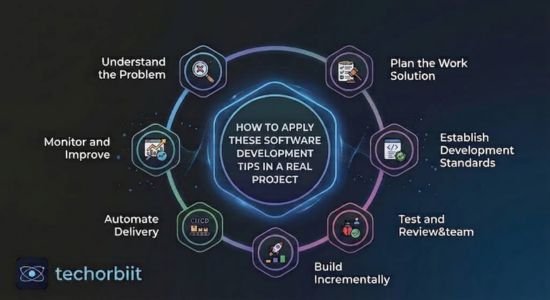
These practices become more effective when combined into a repeatable workflow.
Step 1: Understand the Problem
Identify users, requirements, constraints, and expected outcomes.
Step 2: Plan the Solution
Choose an appropriate architecture without adding unnecessary complexity.
Step 3: Break the Work Into Tasks
Divide large requirements into smaller pieces that can be implemented and tested independently.
Step 4: Establish Development Standards
Define coding, Git, testing, documentation, and review practices.
Step 5: Build Incrementally
Implement smaller pieces instead of waiting until the entire application is complete.
Step 6: Test and Review
Test changes and use code reviews to identify defects, security issues, and maintainability concerns.
Step 7: Automate Delivery
Use CI/CD for repeatable checks and deployment tasks.
Step 8: Monitor and Improve
Track errors, performance, availability, and user feedback, then use that information to decide what should be fixed or improved next.
Common Software Development Mistakes to Avoid
Coding Before Understanding Requirements
Unclear requirements can create expensive rework later.
Treating Testing as Optional
Untested code increases the risk of regressions and makes future changes harder to trust.
Overengineering
Not every application needs microservices, complex cloud infrastructure, or multiple abstraction layers. Use complexity only when it solves a real problem.
Ignoring Technical Debt
Temporary shortcuts can become permanent problems. Track important technical debt and address it before it significantly slows development.
Following Every Technology Trend
A popular technology is not automatically the right choice. Evaluate tools according to actual project requirements.
Trusting AI-Generated Code Without Review
AI-generated code can contain incorrect logic, security weaknesses, inefficient approaches, or unsuitable dependencies. Review it carefully before using it.
Drovenio Software Development Tips Checklist
Before completing an important feature or release, check that:
- Requirements are clearly defined.
- User needs are understood.
- Unnecessary complexity is avoided.
- Code follows consistent standards.
- Sensitive information is protected.
- Dependencies are reviewed.
- Important functionality is tested.
- Critical integrations are validated.
- Code has been reviewed.
- Important technical decisions are documented.
- Performance has been measured where necessary.
- CI/CD checks are automated.
- Production behavior is monitored.
- AI-generated code has been reviewed.
- Accessibility and usability have been considered.
- Technical debt is tracked.
- User feedback is considered.
Frequently Asked Questions
What are Drovenio software development tips?
“Drovenio software development tips” refers to practical software development guidance associated with the broader technology context of Droven.io. It is not the name of a formal programming framework or proprietary methodology.
Is Droven.io a software development framework?
The phrase should not be interpreted as a framework that developers install to build applications. The guidance discussed here consists of general software engineering practices.
What should beginners learn first?
Beginners should prioritize programming fundamentals, problem-solving, debugging, clean code, version control, and basic testing.
Why is version control important?
Version control allows developers to track changes, collaborate safely, review work, experiment with features, and recover previous versions.
Should developers use AI coding tools?
AI coding tools can assist with repetitive tasks, explanations, testing ideas, and development work. Developers should verify generated code for correctness, security, performance, and maintainability.
What is the most important software development practice?
There is no single practice that works for every project. Strong development combines clear requirements, maintainable code, testing, security, version control, review, documentation, and continuous improvement.
How can developers improve their skills?
Build real projects, strengthen programming fundamentals, practice debugging, study existing code, read documentation, learn from reviews, and focus on technologies relevant to your goals.
Conclusion
Effective software development requires clear requirements, clean code, testing, security, version control, code review, and continuous improvement. Developers should also measure performance, automate repetitive work, and review AI-generated code carefully.For anyone searching for Drovenio software development tips, the best approach is to apply practical software engineering principles to real projects and improve them throughout the development lifecycle.