
Machine learning is moving into a more practical stage. Instead of focusing only on larger models and impressive demonstrations, businesses are paying more attention to how machine learning can solve real problems, reduce costs, improve decisions, and operate reliably in production. Recent surveys of enterprise AI adoption show that nearly nine in ten organizations now use AI in at least one business function, yet most haven’t scaled it across the enterprise — the gap between experimenting with AI and running it reliably is where the real competition now happens.
This shift is driving interest in Droven.io machine learning trends and the wider developments shaping machine learning in 2026: AutoML, smaller models, edge AI, agentic systems, AI observability, MLOps, multimodal systems, responsible AI, and AI security. These aren’t isolated technologies — they’re connected to a larger change in how organizations build, deploy, monitor, govern, and use machine learning.
What Are Droven.io Machine Learning Trends?
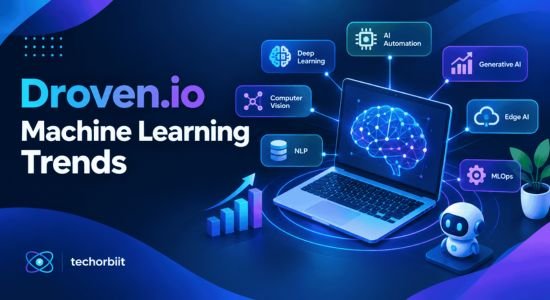
The phrase Droven.io machine learning trends generally refers to machine learning developments and emerging technologies discussed in connection with Droven.io and its broader technology-focused content. These trends cover more than model development — they include the tools, infrastructure, data practices, deployment methods, automation techniques, and governance approaches that shape how machine learning is actually used.
In 2026, several areas stand out:
- Smaller and more efficient models
- AutoML and easier model development
- Multimodal machine learning
- Agentic AI and ML agents
- Edge and on-device ML, plus physical AI
- Data-centric ML and synthetic data
- MLOps and AI observability
- RAG and domain-specific models
- Responsible, explainable, and regulated AI
- Privacy-preserving and confidential computing
- AI security platforms
- Measurable, ROI-driven business applications
Together, these show machine learning moving from experimentation toward everyday implementation.
Why Machine Learning Trends Matter in 2026
Machine learning is already used for fraud detection, recommendations, forecasting, document processing, customer support, cybersecurity, and demand planning. Stanford’s AI Index research has noted that while generative AI use is now widespread across organizations, deployment of autonomous AI agents remains in the low single digits for most business functions — adoption and true operational maturity are still two different things.
Businesses are asking harder questions now: Can the model run at an acceptable cost? Does it fit existing systems? How is performance monitored after launch? Can sensitive data stay protected? These questions separate useful developments from technology that’s interesting mainly because it’s new.
1. Smaller and More Efficient Models
One of the most important shifts in machine learning is growing interest in smaller, specialized models. Large models remain valuable for complex reasoning and flexible applications, but many business problems — like sorting support tickets into billing, delivery, returns, and technical categories — don’t need the largest available model.
Smaller models offer lower inference costs, faster responses, reduced hardware needs, easier deployment, and better privacy when run locally. Industry cost tracking shows the price of running a model at a fixed capability level has dropped dramatically over just a couple of years, thanks to more efficient architectures and cheaper hardware. This makes a mixed approach realistic: a small model handles routine work while a larger one is reserved for harder requests.
2. AutoML Is Making Machine Learning More Accessible
Automated machine learning (AutoML) reduces the manual work of data preparation, feature engineering, model selection, and tuning. It’s particularly valuable for organizations with data but no large machine learning team — analysts and technical staff can experiment with models without handling every stage manually.
AutoML doesn’t eliminate human expertise — someone still has to judge whether the data is appropriate and the output reliable enough for production. The real trend isn’t “AI replaces data scientists,” it’s less repetitive work, freeing specialists for higher-value decisions.
3. Multimodal Machine Learning Is Expanding

Multimodal systems combine text, images, audio, video, documents, and sensor data instead of processing one format at a time. An insurance workflow could combine a customer’s written description, damage photographs, and repair documents. A manufacturing system could combine equipment images with temperature and vibration readings to catch a developing fault.
The real advantage isn’t more formats — it’s context. Considered together, different data sources let a system make more informed predictions than any single input would allow alone.
4. Agentic AI Is Moving ML Beyond Chatbots
Agentic AI is one of the most talked-about trends heading into 2026 — multiagent systems now appear on several major analyst lists of top strategic technology trends for the year. Unlike a chatbot that mainly answers questions, an agent can interpret a goal, choose between tools, complete several connected steps, and hand off to a human when something falls outside its limits.
A procurement agent, for example, could review an order, check inventory, identify approved alternative suppliers, and prepare a comparison for a manager who still makes the final call. That checkpoint matters: giving a system access to business tools without clear limits can create expensive mistakes quickly. The strongest implementations stay narrow and closely supervised — a dependable agent handling one workflow well beats an ambitious one that behaves unpredictably.
5. Edge Machine Learning and Physical AI
Not every prediction should travel to a remote server and back. Edge machine learning processes data close to where it’s generated — factory cameras inspecting products, vehicles detecting obstacles, farm sensors flagging unusual moisture, or retail systems tracking foot traffic without uploading identifiable video. This reduces latency and bandwidth use, and can improve privacy since raw data never has to leave the device.
A related trend is physical AI — machine learning connected to robots, drones, and smart equipment that can sense, decide, and act in the real world, from warehouse robots to predictive maintenance. The most practical setup is usually hybrid: immediate decisions happen locally, heavier analysis happens in the cloud.
6. Data Quality and Synthetic Data
Having more data doesn’t automatically produce better results. Fragmented databases, inconsistent records, and poorly labeled datasets can make even a sophisticated model unreliable. This is why data-centric machine learning — better labeling, cleaning, documentation, and data lineage — is becoming as important as model architecture.
Synthetic data is gaining attention where real examples are limited, sensitive, or dangerous to collect — fraud testing, rare medical conditions. It isn’t a substitute for real data; if its assumptions are wrong, a model learns those errors. It works best as a tested supplement.
7. MLOps and AI Observability
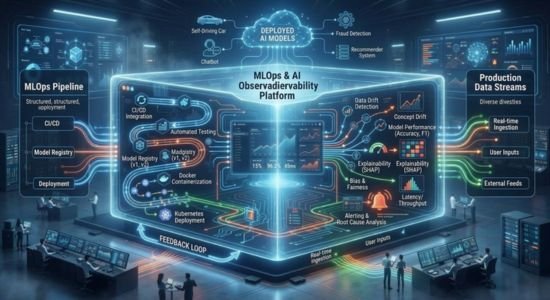
Training a model is only one part of the job. Once deployed, it needs monitoring, updating, securing, and connecting to the business. MLOps covers versioning, automated deployment, drift detection, retraining, and rollback — the discipline that keeps a model useful after launch.
AI observability is the next layer: tracking accuracy, latency, cost, hallucination risk, and failed outputs in real time, especially where AI touches customer service or healthcare. A forecasting model that worked well last year can quietly become less accurate as behavior shifts — observability catches that decline early.
8. RAG, Vector Databases, and Domain-Specific Models
Retrieval-Augmented Generation (RAG) lets an AI system pull information from a trusted internal knowledge base — policies, product documents, support tickets — before answering, instead of relying only on training data. Vector databases support this by matching on meaning rather than exact keywords, making RAG central to enterprise chatbots and internal search.
Alongside RAG, domain-specific models trained for one industry — healthcare imaging, financial risk scoring, legal contract review — are growing because they offer better accuracy, lower cost, and stronger regulatory fit than general-purpose models for narrow, high-stakes tasks. Some forecasts expect most enterprise generative AI models to be domain-specific within a few years.
9. Responsible, Explainable, and Regulated AI
As machine learning influences more decisions — healthcare, finance, insurance, lending, employment — people need to understand the factors behind a result and have a way to challenge an incorrect one. Frameworks like the NIST AI Risk Management Framework help organizations manage AI’s risks, and rules like the EU AI Act add binding transparency and human-oversight requirements on set timelines.
Good governance starts before deployment: defining what a system should and shouldn’t do, what data it uses, how it was tested, and when human review is required — not paperwork added after something goes wrong.
10. Privacy-Preserving ML and Confidential Computing
Machine learning often needs large amounts of data, but organizations can’t always centralize sensitive information. Federated learning lets models train across distributed data sources without moving raw data into one repository — useful wherever privacy rules make centralization risky. Confidential computing adds another layer, protecting data while it’s actively processed, useful for a hospital training on patient records or companies collaborating without exposing raw data. Neither fits every situation, but the direction is clear: capability without unnecessarily exposing sensitive information.
11. AI Security Platforms
As AI systems gain more autonomy, they create new risks: prompt injection, data leakage, model poisoning, and unauthorized agent actions. AI security platforms — a category some analysts now rank among the top strategic technology trends — help centralize visibility, enforce usage policies, and guard against these AI-specific risks. For any business giving an agent access to real tools, this is no longer optional.
12. Machine Learning Is Becoming More Business-Focused
Perhaps the most important trend isn’t a specific technology — it’s the shift toward measurable value. Instead of asking “can we deploy an AI model?”, businesses ask whether it can reduce support workload, improve forecasting, or detect fraud earlier. Useful KPIs include cost savings, time saved, accuracy improvement, and model uptime. A small model solving a clear business problem beats an advanced system with no measurable purpose.
How These Trends Work Together
These developments form a connected ecosystem, not separate technologies: AutoML eases development, smaller models cut deployment cost, edge ML moves inference closer to users, MLOps and observability keep systems monitored, RAG connects models to business knowledge, and responsible AI plus security platforms govern all of it. Adopting one piece without the rest of the lifecycle can solve one problem while creating another.
What Businesses Should Consider Before Adopting
- Define the business goal — the specific problem to solve.
- Evaluate the data — accurate, relevant, complete, and legal to use.
- Choose the right model — match it to the task, not the newest option.
- Calculate the full cost — infrastructure, monitoring, and updates, not just training.
- Plan for monitoring — never deploy and forget.
- Protect sensitive information — review access controls and security risk.
- Keep humans involved — high-impact decisions may need human review.
Who Can Benefit From Following These Trends
Business leaders can see where machine learning creates practical value; developers and IT teams can track shifts in deployment and model operations; students get a practical entry point beyond basic algorithms; marketers can see how prediction and personalization affect their work. Treat trend content as a starting point, not a replacement for technical documentation or professional advice.
The Future of Machine Learning
The future of machine learning won’t be defined by one technology. Progress will come from combining capable models with better data, efficient infrastructure, agentic automation, observability, security, and human oversight. Smaller models may handle routine tasks while larger ones handle complex workloads; edge systems process locally while the cloud handles broader analysis. Organizations will also need stronger governance as machine learning gets embedded deeper into everyday decisions. The next stage isn’t only about more powerful models — it’s about making them more useful, trustworthy, and manageable.
Frequently Asked Questions
What are Droven.io machine learning trends?
Machine learning developments and technology topics associated with the broader ML and AI landscape covered around Droven.io — including AutoML, MLOps, edge ML, agentic AI, RAG, and responsible AI.
What are the most important machine learning trends in 2026?
Smaller models, AutoML, multimodal ML, agentic AI, edge and physical AI, data-centric development, MLOps and AI observability, RAG, responsible AI, and AI security platforms.
Is AutoML replacing machine learning experts?
No. It automates parts of model development, but human expertise still matters for data quality, evaluation, and deployment decisions.
What’s the difference between an AI agent and a chatbot?
A chatbot mainly answers questions. An agent can pursue a goal through multiple steps, use tools, and take action within defined permissions.
What is RAG in machine learning?
Retrieval-Augmented Generation lets a system pull information from a trusted knowledge base before answering, instead of relying only on training data.
Why is MLOps important?
It helps monitor, version, test, and retrain models after deployment, since real-world conditions change and accuracy can quietly decline.
Why does data quality matter?
A model learns from its data. Incomplete, biased, or poorly structured data produces unreliable predictions.
Should every business adopt the latest trend?
No. Adoption should be based on a specific problem, available data, expected value, cost, and risk — not popularity.
Conclusion
The biggest Droven.io machine learning trends for 2026 point toward a more practical, more governed approach to AI. Machine learning is becoming easier to deploy, more connected to business workflows, and more focused on measurable outcomes. Smaller models, AutoML, agentic AI, RAG, edge computing, better data, MLOps and observability, and responsible AI are all driving this shift.The lesson is simple: the best machine learning technology isn’t necessarily the newest or largest model — it’s the one that solves the right problem reliably, efficiently, and responsibly, with the monitoring and governance in place to keep it that way.