
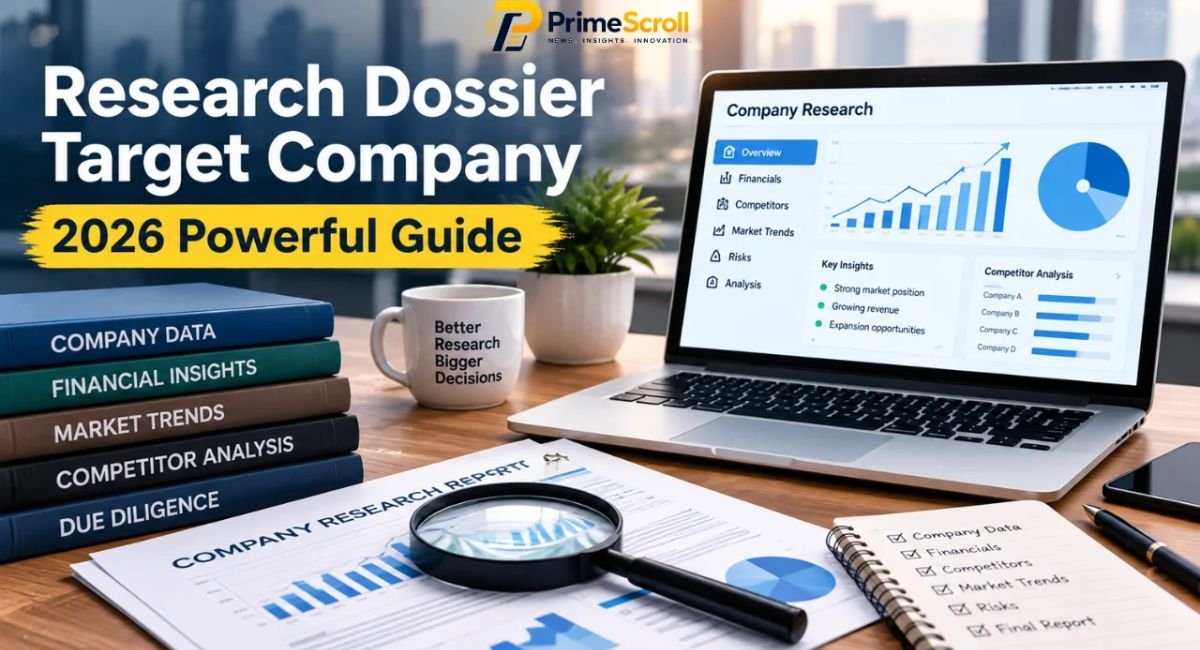
A research dossier for a target company is a structured report that brings together important information about a business to support informed decisions. It can help sales teams understand potential clients, investors evaluate opportunities, companies assess partners, and researchers analyze competitors.
Instead of collecting scattered information from websites, news articles, corporate records, and industry reports, a dossier organizes relevant findings in one place. It explains what the company does, who owns it, how it operates, where it competes, and which opportunities or risks deserve attention.
The purpose is not simply to collect as much information as possible. A useful dossier connects verified facts with meaningful analysis, highlights missing information, and answers the questions that matter to the person using it.
What Is a Research Dossier for a Target Company?

A research dossier for a target company is an organized collection of company information prepared for a specific business purpose.
The term target company generally means the business being researched. It does not necessarily refer to Target Corporation, the American retail company.
Depending on the research objective, a dossier may contain:
- Company background and legal identity
- Ownership structure and leadership
- Products, services, and business model
- Target customers and markets
- Competitors and industry position
- Financial information and funding history
- Reputation and media coverage
- Legal, regulatory, and operational risks
- Recent developments and strategic priorities
- Potential opportunities and unanswered questions
The exact contents depend on why the company is being investigated. A sales team researching a prospective customer needs different information from an investor considering an acquisition.
A strong dossier begins with that purpose and focuses on the evidence needed to support it.
Why Is a Target Company Research Dossier Important?
Businesses make decisions involving money, time, resources, and long-term relationships. Incomplete research can lead to misunderstandings, missed opportunities, or unnecessary risks.
A research dossier helps bring relevant information together before a decision is made.
1. Understand the Business
A company’s website may describe its products and mission, but a dossier examines the wider picture. It can explain how the business generates revenue, which customers it serves, and what distinguishes it from competitors.
2. Identify Business Opportunities
Research may reveal new markets, potential partnerships, customer needs, expansion plans, or gaps in the company’s current offerings.
3. Recognize Potential Risks
Financial uncertainty, regulatory issues, customer concentration, leadership changes, and reputational concerns may require further investigation.
4. Improve Sales and Outreach
Sales professionals can use company research to understand a prospect’s priorities and prepare relevant conversations instead of sending generic messages.
5. Support Investment and Partnership Decisions
Investors, suppliers, and potential partners can use a dossier to identify important questions before committing resources.
A dossier does not guarantee a successful decision. Its value lies in improving the quality of the available information and making uncertainty easier to recognize.
What Should a Research Dossier Include?
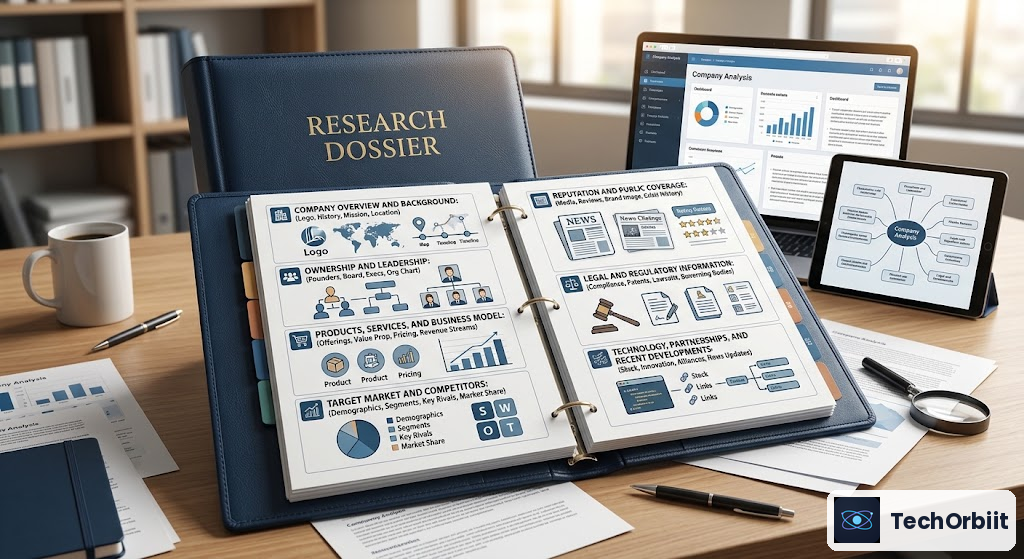
A useful dossier covers the major areas needed to understand a company without becoming an unorganized collection of facts.
1. Company Overview and Background
Start with the company’s basic identity.
Include its legal name, trading name, official website, headquarters, operating locations, industry, founding date, and relevant registration details.
Explain what the company does in straightforward language. Avoid relying entirely on promotional descriptions from its website.
Also check whether the business has changed its name, merged with another organization, or become part of a larger corporate group. These details can affect how its history and ownership should be understood.
2. Ownership and Leadership
Identify the people and organizations responsible for ownership, control, and management.
Depending on the company’s structure, this section may include founders, major shareholders, parent companies, subsidiaries, directors, and senior executives.
Distinguish between ownership and management. A chief executive may run the business without owning it, while an investor may influence decisions without managing daily operations.
Leadership backgrounds and recent executive changes can also provide useful context about the company’s direction.
3. Products, Services, and Business Model
Explain what the company sells, who purchases it, and how it delivers value.
For example, a software business may generate revenue through subscriptions, licensing, consulting, or implementation services. A manufacturer may earn revenue through physical products, distribution agreements, and long-term supply contracts.
Where evidence is available, examine customer concentration, recurring revenue, major product lines, and dependence on particular markets.
The objective is to understand how the business operates rather than simply repeat its product descriptions.
4. Target Market and Competitors
Analyze the market in which the company operates.
Consider its customer segments, geographic reach, industry trends, competitive pressures, and major alternatives available to customers.
Competitor research should include both direct and indirect competitors. A business may compete with similar companies, but customers might also choose an internal solution, a different technology, or no purchase at all.
Compare products, pricing approaches, positioning, customer groups, and publicly documented strengths or limitations.
5. Financial Information
Financial information can be essential when researching a company for investment, acquisition, lending, or partnership purposes.
Depending on availability, examine revenue, profitability, funding rounds, debt, cash flow, major investments, acquisitions, and other relevant indicators.
Public companies generally provide more financial disclosures than private businesses. When reliable figures are unavailable, identify the gap instead of estimating numbers without evidence.
Financial indicators should also be interpreted in context. Revenue growth, for example, does not automatically mean a business is profitable or financially stable.
6. Reputation and Public Coverage
Review how the company is discussed by customers, employees, industry publications, and other credible sources.
Relevant material may include customer reviews, independent reporting, public announcements, industry recognition, and documented complaints.
Do not treat every online comment as a verified fact. Look for recurring patterns and check important claims against additional sources.
7. Legal and Regulatory Information
Depending on the industry and research purpose, examine public litigation records, regulatory actions, intellectual-property disputes, compliance matters, and relevant government announcements.
Present legal information carefully. The existence of a lawsuit does not establish that a company has committed wrongdoing.
Record the nature and status of a case, the source of the information, and any relevant outcome. For consequential decisions, specialist legal review may be necessary.
8. Technology, Partnerships, and Recent Developments
Technology and partnerships can reveal how a company operates and where it may be heading.
Research its digital products, visible technology strategy, major customers, strategic alliances, hiring activity, expansion announcements, and recent leadership changes.
A new partnership or recruitment campaign may indicate a potential strategic priority, but it does not prove that a particular business plan will succeed.
Separate confirmed developments from your interpretation of what they might mean.
How to Create a Research Dossier for a Target Company
Following a repeatable process makes research easier to organize, verify, and update.
Step 1: Define the Research Objective
Decide why the company is being researched.
Is the goal to find a potential customer, assess an acquisition, evaluate a supplier, study a competitor, or investigate a possible partnership?
Write down the main questions the dossier must answer. This prevents time being wasted on details that do not support the intended decision.
Step 2: Confirm the Company’s Identity
Verify the exact business before collecting detailed information.
Companies can share similar names, use different trading names, or operate through multiple legal entities. Confirm the official website and, where relevant, the registered company name and jurisdiction.
This step helps prevent information from being attributed to the wrong organization.
Step 3: Gather Information From Reliable Sources
Start with primary sources wherever possible.
Useful sources include:
- Official company websites and announcements
- Annual reports and investor disclosures
- Government business registries
- Securities filings and regulatory records
- Court records and official legal documents
- Company leadership profiles
- Reputable industry publications
- Established news organizations
- Verified customer or partner announcements
Company-controlled sources can explain what the business claims about itself. Independent sources help provide additional context and test important claims.
Step 4: Verify Important Claims
Do not accept every statement at face value.
Check important names, dates, financial figures, ownership details, and business relationships against reliable evidence. For significant claims, seek confirmation from more than one credible source when possible.
If two sources disagree, record the discrepancy and investigate which source is more authoritative or current.
Step 5: Organize Findings Into Sections
Group the research into logical categories such as company background, ownership, products, financials, competitors, reputation, and risks.
Record the source and publication date alongside important facts. This makes the dossier easier to review and update later.
Step 6: Analyze the Evidence
Move beyond description by explaining why the findings matter.
For example, a company opening a new office is a verifiable event if confirmed by a reliable source. Interpreting that move as evidence of market expansion is an analysis that should be supported by additional context.
Keep facts, interpretations, assumptions, and unresolved questions clearly separated.
Step 7: Summarize Opportunities and Risks
Finish with the findings most relevant to the research objective.
Identify potential opportunities, significant risks, missing information, and questions requiring further investigation. Avoid presenting speculation as a confirmed conclusion.
Research Dossier vs. Company Profile vs. Due Diligence
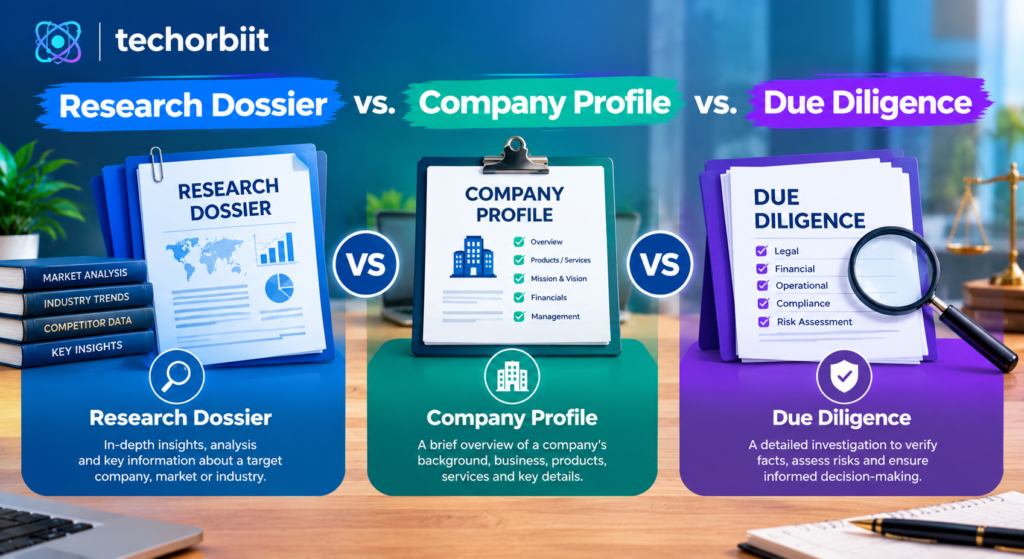
These terms are related, but they serve different purposes.
| Feature | Company profile | Research dossier | Due diligence |
| Main purpose | Describe a business | Support a specific decision | Examine a transaction or relationship in depth |
| Typical content | Background, products, locations | Background, analysis, competitors, risks, evidence | Financial, legal, tax, operational, and other detailed reviews |
| Research depth | Usually introductory | Depends on the objective | Often extensive |
| Sources | Frequently company information | Company and independent sources | Public and, where authorized, confidential records |
| Main users | General readers and business contacts | Sales teams, analysts, investors, researchers | Buyers, investors, lenders, advisers, and transaction teams |
A research dossier can be an early step toward due diligence, but it does not automatically replace a formal professional review.
Common Mistakes to Avoid
Even a detailed dossier can be misleading if the research process is weak.
Relying on one source:
A company’s website is useful, but it cannot answer every question independently.
Using outdated information:
Former executives, old financial figures, and discontinued products can create an inaccurate picture. Record dates and check whether details remain current.
Confusing facts with assumptions:
An executive departure is a factual event when verified. Its supposed cause requires separate evidence.
Ignoring negative or conflicting evidence:
Relevant concerns should be investigated fairly rather than omitted because they contradict a company’s promotional claims.
Treating allegations as proven facts:
Legal claims, customer complaints, and media reports require context and careful attribution.
Collecting information without a purpose:
A long report is not necessarily useful. Prioritize evidence that answers the questions defined at the start.
Filling gaps with guesses:
Clearly stating that a fact could not be verified is more reliable than inventing an answer.
Research Dossier Template for a Target Company
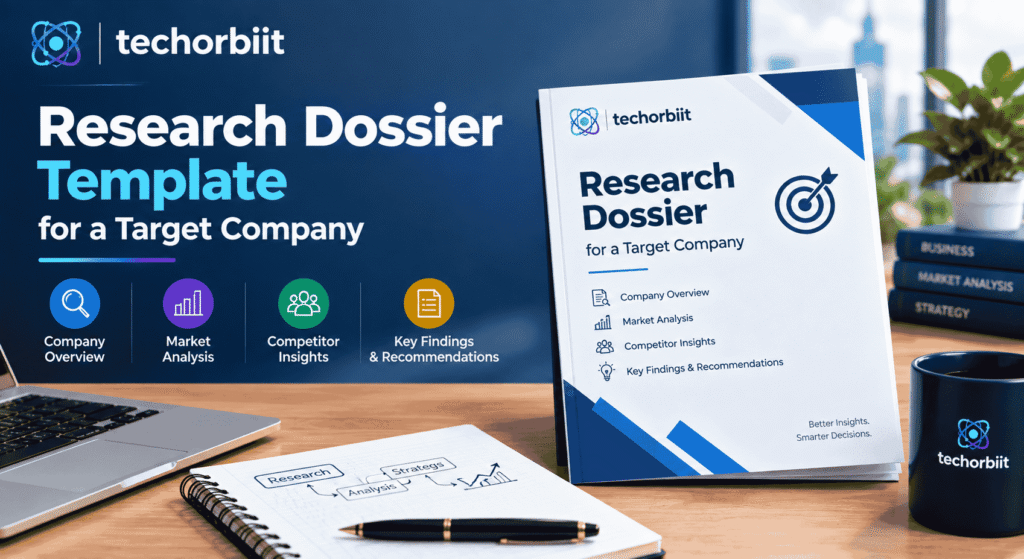
Use the following structure as a starting point for your own report.
| Section | Information to record |
| Company identity | Legal name, website, location, industry |
| Business overview | Products, services, customers, business model |
| Ownership | Owners, parent company, subsidiaries, where verifiable |
| Leadership | Key executives and relevant professional backgrounds |
| Market | Customer segments, industry trends, geographic reach |
| Competitors | Direct competitors and alternative solutions |
| Financials | Available revenue, funding, profitability, debt, and related data |
| Reputation | Media coverage, customer feedback, public recognition |
| Legal and regulatory | Relevant documented cases, actions, or compliance matters |
| Recent developments | Partnerships, launches, expansion, leadership changes |
| Opportunities and risks | Evidence-based findings relevant to the objective |
| Research gaps | Unverified details and questions requiring follow-up |
| Sources and dates | URLs, document titles, publication dates, access dates |
This format can be adapted for a sales prospect, acquisition target, potential supplier, investment candidate, or competitor.
Frequently Asked Questions
What is a research dossier for a target company?
It is a structured report that gathers and analyzes information about a specific business to support research, sales, investment, acquisition, partnership, or risk-assessment decisions.
What is the most important part of a company research dossier?
It depends on the objective. Ownership and financial information may be central to an acquisition, while decision-makers, customer needs, and business priorities may matter more when researching a sales prospect.
Where can I find information for a target company dossier?
Start with official company sources, public filings, government registries, regulatory records, reputable news outlets, industry publications, and other sources appropriate to the company and jurisdiction.
How long should a research dossier be?
There is no universal length. A brief sales-research document may need only a few pages, while an investment or acquisition investigation can require substantially more information. Relevance and accuracy matter more than page count.
Can AI help create a research dossier?
AI tools can help organize notes, summarize documents, identify research questions, and structure findings. However, important claims, citations, financial figures, and legal details should be independently verified. AI-generated statements should not be treated as evidence by themselves.
What is the difference between a target company and Target Corporation?
In business research, a target company is the organization being investigated. The phrase does not necessarily refer to Target Corporation, the U.S. retailer.
Can a research dossier replace due diligence?
No. A dossier can support preliminary analysis, but significant transactions may require professional legal, financial, tax, operational, and technical due diligence.
Conclusion
A research dossier for a target company brings scattered information into a structured report that supports better-informed business decisions.
The process starts with a clear objective, confirms the company’s identity, gathers reliable evidence, examines ownership and leadership, evaluates the business model and competition, and reviews relevant financial, reputational, legal, and strategic information.
The final report should distinguish verified facts from interpretation and identify important gaps rather than filling them with assumptions.
Ultimately, the value of a company research dossier comes from the quality of its evidence and the relevance of its findings—not simply the amount of information it contains.